


National Health Insurance Bureau Releases 2019 Medical Security Development Statistics Express
Release time:
2020-04-09
Recently, the National Health Insurance Bureau released the 2019 Medical Security Development Statistics Express. According to KuaiBao data, in 2019, the number of people participating in full-caliber basic medical insurance was 1354.36 million, and the coverage was stable at more than 95%; the total income and total expenditure of the basic medical insurance fund for the whole year were 2333.487 billion yuan and 1994.573 billion yuan respectively, with a cumulative balance of 2691.211 billion yuan at the end of the year.
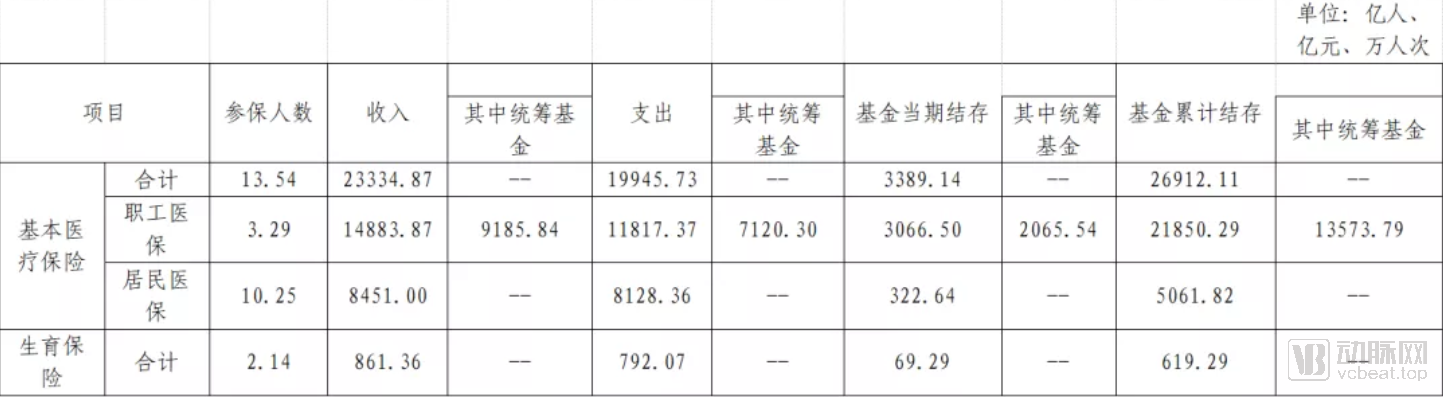
(2019 National Medical Security Express Key Indicators)
In the 2019 edition of the National Health Insurance Drug List, there are a total of 2709 western medicines and proprietary Chinese medicines, of which 1370 are western medicines and 1339 are proprietary Chinese medicines. In addition, 892 pieces of traditional Chinese medicine with national standards have been included.
In terms of drug procurement, by the end of 2019, the total amount of orders collected by 31 provinces (autonomous regions and municipalities) through the provincial centralized drug procurement platform network was 991.3 billion yuan. Among them, the order amount of western medicine (chemical drugs and biological products) is 811.5 billion yuan, and the order amount of Chinese patent medicine is 179.8 billion yuan. The order amount of medical insurance drugs in the online drug collection was 832.7 billion yuan, accounting for 84%.
By the end of 2019, the 25 selected drugs in the "4+7" drug centralized band procurement pilot areas had completed an average of 183 percent of the agreed procurement volume, and the procurement volume of selected drugs accounted for 78 percent of the same generic drug procurement volume. After the pilot nationwide expansion, all 25 generic varieties were successfully purchased, with the average price reduction of 59% and another 25% reduction on the basis of the "4+7" pilot.
In terms of medical insurance payment methods, 97.5 per cent of the country's co-ordinated districts have implemented total medical insurance payment control, and 86.3 per cent of the co-ordinated districts have implemented disease-based payment. Thirty cities were included in the national CHS-DRG payment pilot. More than 60% of the co-ordination areas carry out bed-day payment for long-term and chronic disease inpatient medical services, and explore the combination of per-head payment for primary medical services and chronic disease management.
On the direct settlement of cross-provincial medical treatment, as of the end of 2019, the number of cross-provincial medical direct settlement medical institutions was 27608. The coverage of primary medical institutions continued to expand, with 24720 designated medical institutions at the second level and below. In the whole year, 2.72 million people were directly settled for medical treatment in different places across provinces, with medical expenses of 64.82 billion yuan and fund payment of 38.32 billion yuan. The average hospitalization cost is 24000 yuan, and the average fund pays 14000 yuan. All 41 cities in the Yangtze River Delta region have achieved full coverage of direct settlement of outpatient expenses for cross-provincial medical treatment in different places, and five southwestern provinces (Yunnan, Guizhou, Sichuan, Chongqing, and Tibet) have initiated direct settlement of outpatient expenses for cross-provincial medical treatment in different places.
In the supervision of medical insurance funds, a total of 264000 illegal and breaching medical institutions were investigated and dealt with throughout the year. A total of 33100 people were insured in violation of laws and regulations. A total of 11.556 billion yuan was recovered throughout the year.
Only 22 months since its establishment, the report card handed over by the National Health Insurance Bureau is not eye-catching.
When the medical reform enters the deep water area, when the traditional medical system meets new technologies and new ideas, the National Medical Insurance Administration seems to be a helmsman who has seen both reality and a long distance. He carefully makes a choice between the new and the old, and uses one new policy after another to let the big ship of China's medical reform sail towards the coast of healthy China.
Policy Insights: Determination and Reform Direction of National Health Insurance Bureau
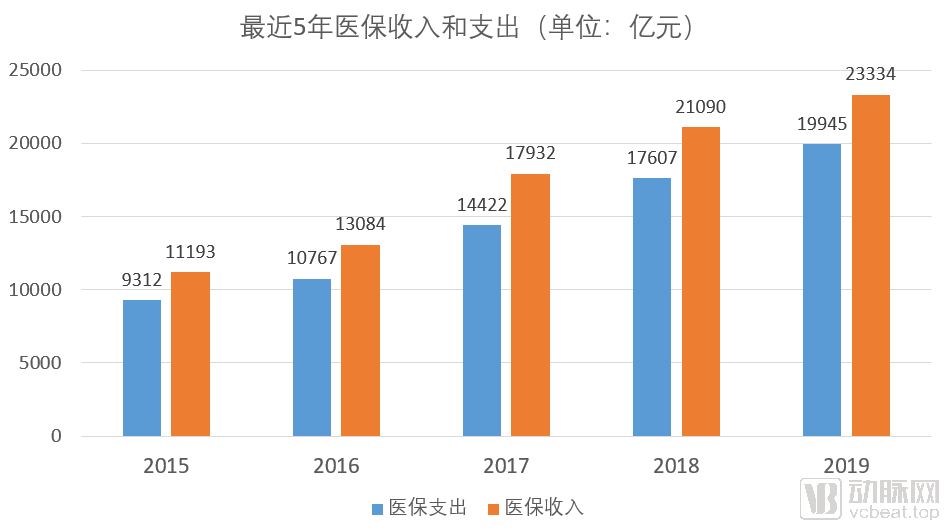
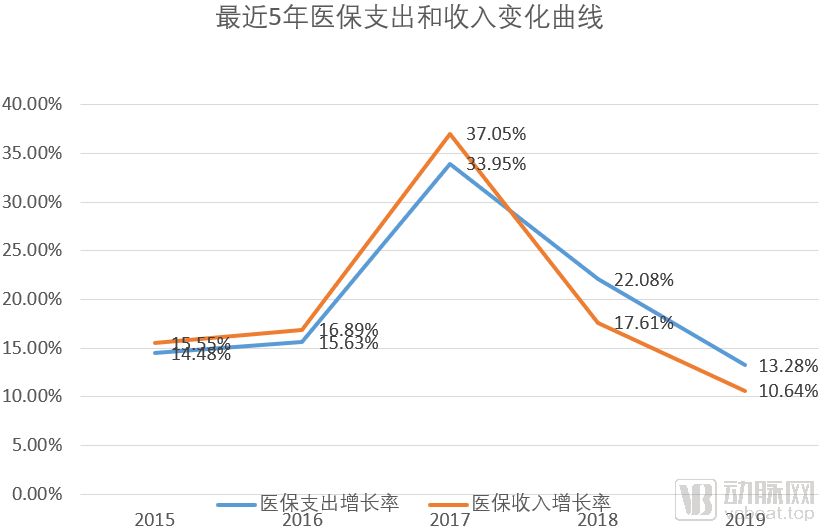
In recent years, with the rise of medical expenses, medical insurance is facing greater pressure. As we can see from the chart, while health care spending has not grown as much as the health care balance in absolute terms, the former has outpaced the latter in terms of growth. In the long run, the medical insurance fund will face the risk of deficit, which breaks the principle of "setting expenditure by income, ensuring balance, resisting risk and not going through the bottom" in the management of medical insurance fund.
Medical insurance is related to the national economy and people's livelihood, the importance of natural self-evident. Thus, in the context of the institutional reform of the State Council, the National Health Insurance Bureau was born. On May 31, 2018, the National Health Insurance Bureau was established in the spotlight. In the past, the management functions scattered in four departments were unified to the National Health Insurance Bureau, and a "super buyer" in the medical and health industry was born.
The National Health Insurance Bureau is positioned as the main purchaser of medical services in order to better play its decisive role in the development of the medical service system and the allocation of health resources. In terms of organizational structure, the National Medical Insurance Administration has set up "six departments and one office", and the leadership team is equipped with one bureau and three deputy directors. Hu Jinglin, the former vice minister of the Ministry of Finance, served as the first director of the National Medical Insurance Administration.
Soon after its establishment, the National Medical Insurance Administration issued the first blockbuster policy, "Notice on Carrying out Provincial-level Special Centralized Procurement of Anticancer Drugs," in response to issues that were strongly reflected by the society and people's livelihood.
With this as the beginning, the National Medical Insurance Administration opened a series of reforms that have a far-reaching impact on the industry around the work direction of medical insurance fund management, medical insurance catalog adjustment and drug prices. After combing and analyzing all the policies disclosed in the official website of the National Health Insurance Administration, the arterial network selected five areas with far-reaching policy impact from the perspective of the industry, namely, Internet medical care, medical insurance catalog adjustment, centralized drug procurement, medical insurance information construction, DRGs.
1. Internet medical
In the past, the industry generally believed that the failure of medical insurance payment would become a huge obstacle to the development of the Internet medical industry.
On August 30, 2019, the National Health Insurance Administration's "Guiding Opinions on Improving the" Internet "Medical Service Price and Medical Insurance Payment Policy" was issued, breaking the ice and removing obstacles to the development of the industry.
The medical insurance policy guidance proposes that online and offline medical services implement fair price and payment policies; the "Internet" medical services provided by designated medical institutions are the same as the offline medical services within the scope of medical insurance payment, and the corresponding public If the charging price of a medical institution is included in the scope of medical insurance payment and paid according to regulations after the corresponding filing procedures.
During this new crown epidemic, the National Health Insurance Administration, together with the National Health and Care Commission, issued the "Guidance on Promoting the Development of" Internet "Health Insurance Services during the Prevention and Control of the New Crown Pneumonia Epidemic" on March 2, 2020. This document makes it clear that online follow-up services for common and chronic diseases provided by Internet medical institutions that meet the requirements can be included in the scope of medical insurance fund payment in accordance with regulations. Internet medical institutions issue electronic prescriptions for the insured online, and take a variety of ways to flexibly dispense drugs offline, and the insured can enjoy the treatment of medical insurance payment. The medical insurance department has strengthened its cooperation with Internet medical institutions, etc. The medical insurance burden of diagnosis and treatment fees and medical expenses is settled directly online. The insured person only needs to pay the self-paid part just like swiping a card to buy drugs in a physical hospital.
It can be seen that the policy is bringing more and more tilt to the Internet medical industry.
2. Adjustment of medical insurance catalogue
The national medical insurance catalogue holds 80% of the sales market of public hospitals. For enterprises, if they fail to enter the medical insurance, they will lose the market volume advantage brought by the medical insurance catalogue and fall into the fierce market competition. For consumers, if more life-saving and emergency medicines can be included in medical insurance, they will be able to save money.
On August 20, 2019, the National Health Insurance Administration issued a notice on the issuance of the National Basic Medical Insurance, Work Injury Insurance and Maternity Insurance Drug Catalog, which triggered an industry earthquake. A total of 148 new varieties have been added to the regular access part of the catalogue adjustment, with a total of 150 varieties transferred out.
This major adjustment of the drug catalog is the first comprehensive adjustment since the establishment of the National Medical Insurance Administration. It is also a comprehensive review of the original catalog varieties since the first edition of the drug catalog in 2000. It is only two years after the last round of major adjustments of the medical insurance catalog. time.
From this point of view, the dynamic dynamic adjustment of the medical insurance drug catalog began to return to normalization, and after the dynamic adjustment time is shortened, the medical insurance drug catalog can quickly enter and exit, revitalize the existing medical insurance resources, improve the accessibility of drugs, and play a greater role in the medical insurance fund.
Since January 1, 2020, the new medical insurance catalogue has been implemented.
3. Centralized procurement of drugs
The purpose of centralized drug procurement is to explore and improve the centralized drug procurement mechanism and the market-led drug price formation mechanism, reduce the burden of drug expenses, standardize the order of drug circulation, and improve the safety of drug use by the masses.
After the establishment of the National Medical Insurance Bureau, it has the power of payment, supervision and pricing. The first policy issued is about centralized drug procurement. Since then, relevant policies have been issued many times, and the determination to control drug fees can be seen in general.
In November 2018, the National Health Insurance Bureau, together with the Health Commission, the Food and Drug Administration and other relevant departments, studied and drafted a pilot program. According to the idea of "national organization, alliance procurement and platform operation", the pilot program of "4 7" was launched.
According to the latest data this year, after the pilot nationwide expansion, all 25 generic varieties were successfully purchased, with the average price reduction of 59% and another 25% reduction on the basis of the "4+7" pilot.
Lowering drug prices is the first step to truly separate medicines. The results of centralized drug procurement seem to herald the official opening of the era of medical reform led by medical insurance.
4. Medical insurance information construction
There have been three major problems in my country's medical insurance information system for a long time: first, the standards are not unified, the data are not mutually recognized, and it is impossible to form big data at the national and regional levels, let alone conduct effective big data analysis; the second is system segmentation, It is difficult to share. Almost all the nearly 400 overall planning areas in the country have built their own information systems, and they are scattered in different departments such as human resources and social security, civil affairs, civil affairs, this leads to poor convergence between each other; third, the phenomenon of regional closure and isolated islands is prominent, and the medical insurance data of each overall planning area is managed in a closed way, and each overall planning area is an "isolated island of information." if you can't get in, I can't get out, and everyone entertain themselves.
The establishment of a unified national health insurance information system has become a primary issue facing the National Health Insurance Bureau.
At the 2018 National Medical Insurance Work Conference, the goal of "one, two, three, four" for the construction of medical insurance informatization was put forward, and then the work began to advance steadily. In 2019, the "dynamic maintenance of medical insurance business coding standards" will be put into trial operation on the official website window of the national medical security administration, marking the official landing of the national medical security information platform. among the 15 information business coding standards, the four medical insurance information business codes of "disease diagnosis and surgical operation", "drugs", "medical service items" and "medical consumables" will also be put into operation.
According to the "Guiding Opinions on Medical Security Standardization Work" document, by 2020, on the basis of the construction of a unified national medical security information system, 15 information business coding standards such as disease diagnosis and surgical operations will be gradually implemented. During the "14th Five-Year Plan" period, a list of national medical security standards was formed, and the research, formulation and trial improvement of some medical security standards were initiated.
According to the recent analysis of the winning bid data of medical informatization by Arterial Network, the market size of medical informatization in 2019 is about 58.2 billion yuan, and it will usher in a broad development in the future.
5.DRGs
DRGs payment is a more advanced medical insurance payment method, which has been adopted by the United States, Germany, France and other countries. After a comprehensive analysis of the patient's illness, it is included in different diagnostic groups for packaged treatment, which realizes the standardization of the treatment process and the control of treatment costs.
From the perspective of historical evolution, since 2017, the Health Commission has carried out DRGs collection and payment reform pilot work in three medical institutions in Sanming City, Fujian Province, Shenzhen City, Guangdong Province, Karamay City, Xinjiang Uygur Autonomous Region, and Fujian Province. In January 2018, Sanming City, Fujian Province launched the DRG collection and payment system.
Subsequently, according to the three-step idea of "top-level design, simulation test and actual payment", the National Health Insurance Bureau issued such important documents as "Notice on Declaring National Pilot of Grouping Payment by Disease Diagnosis" and "Notice on Issuing List of Pilot Cities of Grouping Payment Countries by Disease Diagnosis", confirming that DRG payment will be piloted in 30 cities in China.
In 2020, DRG payment has been simulated in 30 pilot cities in China, and will start to practice payment in 2021.
Insight into the future: medical insurance, commercial insurance, network mutual assistance and other multi-level medical security system is being established.
On March 5, 2020, once the Opinions of the Central Committee of the Communist Party of China and the State Council on Deepening the Reform of the Medical Security System (the "Opinions") were released, it caused a huge response in the industry and was evaluated by many industry insiders as a programmatic document that can set the tone for China's medical reform in the next decade.
Although the "opinion" starts with deepening the reform of medical insurance, it goes deep into many parts of the ecology of the medical and health industry, which will have a far-reaching impact on the industry. The "Opinions" put forward the overall reform framework of "1 4 2:
Among them, "1" is to strive to fully establish a multi-level medical security system with basic medical insurance as the main body, medical assistance as the support, and supplementary medical insurance, commercial health insurance, charitable donations, and medical mutual assistance by 2030. "4" is to improve the four mechanisms of treatment guarantee, financing operation, medical insurance payment and fund supervision. "2" is to improve the supply of medical services and medical security services two support.
From the overall goal of this programmatic document, we can see that the status of the National Medical Insurance Bureau as a "super buyer" will gradually fade away. While playing the historical mission of "super buyer", the National Medical Insurance Bureau is actually leading a multi-level The establishment of the medical security system. Judging from the current development trend of the industry, the buyer of medical payment in China is transferring to innovative payers such as market-oriented commercial insurance and network mutual aid.
In 2019, the market size of health insurance will be 706.6 billion yuan. According to the market's compound annual growth rate of more than 30% in the last five years, the market size of health insurance will approach or even exceed trillion yuan this year. It can be seen that commercial insurance will play the same main role as medical insurance in the future multi-level medical security system.
Moreover, the greater opportunity brought by the development of commercial health insurance to the medical and health industry is that with the establishment and popularization of new medical payment methods in the industry, a new medical service model adapted to it will also be established and popularized.
This is a revelation that has been mentioned in the books of philosophers such as McLuhan, Neil Bozeman, Kevin Kelly, and Clayton Christensen.
Source: Arterial Network Author:Fan Xin
Previous Page
Next Page
RELATED INFORMATION

Caring for life, staying away from infections, providing you with more academic programs

Caring for life, staying away from infections, providing you with more academic programs
ANNJET
Company address: 1618 Dexing North Avenue, Tianqu Industrial Park, Tianqu Sub-district Office, Decheng District, Dezhou City, Shandong Province


WebChat