


OBSERVATION ON EFFICACY OF A COMPOUND OPHTHALDEHYDE DISINFECTANT ON DISINFECTION OF BECADES SURFACE
Release time:
2022-08-22
In the past 20 years, due to the increase of floating population, the prevalence of HIV/ AIDS, and the increase of drug-resistant Mycobacterium tuberculosis, the prevention and control of important infectious diseases such as tuberculosis and AIDS have been severe in the world. The remains of these patients who died of AIDS, tuberculosis and other infectious diseases have to be treated by funeral. As an important source of pollution in funeral places, the harm to funeral workers and bereaved families has been widely reported I4. The author has conducted a survey on the microbial contamination of the body surface of a large number of remains in 25 funeral homes across the country, and found that the surface of the remains is seriously contaminated by bacteria. The national standard GB19053-2003 stipulates the safety limits of pathogenic bacteria in various funeral places, requiring the remains to be disinfected in time, and places such as funeral vehicles, mortuaries, plastic surgery rooms, farewell halls, and cremation questions must be disinfected regularly. The investigation also found that the disinfectants used for disinfection of remains in funeral homes were mainly chlorine disinfectants, peracetic acid solution and 75% alcohol. Because peracetic acid and chlorine-containing disinfectants have obvious stimulating effects on human respiratory mucosa and skin, they have corrosion and bleaching effects on metal objects and natural fiber textiles, and may also cause serious damage to funeral vehicles, and large-scale use will also pollute the environment. To this end, the research group after analysis and testing, developed a compound o-phthalaldehyde disinfectant (code x1), after laboratory sterilization tests and on-site disinfection of the surface of the body to observe the effect is good. The results are reported below.
1 Materials and methods
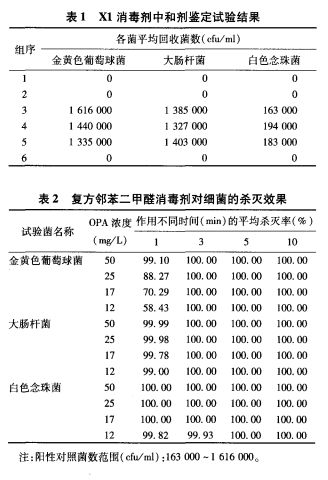
The compound phthalaldehyde disinfectant for 1.1 test materials is developed by the Institute. The content of phthalaldehyde, the main bactericidal component, is 5000mg/L, and is compounded with benzalkonium bromide, alcohols, organic acids and appropriate amount of surfactants. The stock solution is colorless or light yellow solution and can be miscible with water. The disinfectant of the control group was 75% alcohol. The test indicators were Staphylococcus aureus (ATCC6538), Escherichia coli (ATCC 25922) and Candida albicans (ATCC 10231), which were provided by the Experimental Center of Pathogenic Biology of Harbin Medical University. 1.2 Test Method 1.2.1 Bacterial Suspension Preparation Typical colonies of Staphylococcus aureus, Escherichia coli and Candida albicans were isolated and cultured by streaking plates, inoculated on the slant of nutrient agar (sandcastle for Candida albicans) medium, and cultured at 37 ~ C for 24h. The fresh culture of each bacterium was washed with tryptone-containing physiological saline (TPS) to wash the bacterial moss on the sloping surface, and the washing liquid was transferred to a sterile test tube, and the bacterial suspension was prepared for standby after sufficient shaking. 1.2.2 Neutralizer identification test takes Staphylococcus aureus, Escherichia coli and Candida albicans as test strains respectively. According to the requirements of neutralizer identification test specified in the 2002 edition of "Disinfection Technical Specification"], 6 groups of tests are designed and neutralizer identification test is carried out according to the suspension quantitative test procedure. According to the judgment of the test results, the number of bacteria in group 1 is significantly less than that in group 2. The number of bacteria in group 2 is significantly less than that in groups 3, 4 and 5. The number of bacteria in groups 3, 4 and 5 is similar, and the error rate is ≤ 10%. Group 6 grows aseptically. The results of three consecutive repeated tests are consistent, indicating that the selected neutralizer and its concentration are appropriate. 1.2.3 The quantitative germicidal test was carried out under the condition of 20~21 ℃ water bath. First, the bacteriological suspension of disinfectant was kept at constant temperature for 5min. Add 1.0ml of bacterial suspension into a sterile test tube and mix with 4.0ml of disinfectant solution (positive control group is diluent), and act for a predetermined time. Take 0.5ml of bacterial drug mixture, add it to a test tube containing 4.5ml of neutralizer, mix well, and neutralize for 10min. After fully mixing, 1.0 ml of sample solution is sucked for pouring inoculation culture, live bacteria count, and kill value is calculated. The test was repeated 3 times. 1.2.4 The body surface field disinfection test subjects were 30 bodies from a funeral home in Heilongjiang Province, including 19 males and 11 females. Before the test, a test area of 5cm × 5cm was marked on the surface of the body, and the sampling solution was moistened with sterile cotton to smear the designated area for sampling as a positive control. Then the surface of the body was wiped and disinfected with a compound disinfectant containing 17mg/L o-phthalaldehyde for 3 min. Another 1 demarcated area was sampled after disinfection by the same method as above as the experimental group. Cut the sampling cotton swab aseptically into a test tube containing 10ml neutralizer, after full shaking elution, take the eluent for inoculation, culture, live bacteria count, and calculate the killing rate. The test was repeated in 30 parts (times). The evaluation criteria for the results were qualified as the average killing rate of natural bacteria ≥ 90% or the total number of bacteria ≤ 15cfu/cm. Results 2.1 neutralizer identification test results showed that phosphate buffer solution (PBS) containing 4g/L lecithin, 45g/L Tween -80 and 10g/L glycine as neutralizer could effectively neutralize the residual effect of the disinfectant with the highest test concentration on the test bacteria. The neutralizer and its neutralization products were not toxic to the indicator bacteria, and the neutralizer of the disinfectant was judged to be qualified (Table 1). The results of 2.2 quantitative germicidal test showed that the killing rate of Staphylococcus aureus and Escherichia coli in suspension reached 100 when x1 disinfectant containing 17mg/L o-phthalaldehyde was used for 3min. The killing rate of Candida albicans in suspension reached 100 for 5min (Table 2).
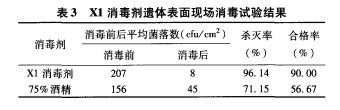
2.3 Disinfection Test Results: Xl disinfectant containing 17mg/L o-phthalaldehyde was used to wipe and disinfect the surface of the body for 3min, with an average killing rate of 96.14 for natural bacteria, and 75% alcohol was used to wipe and disinfect in the same way, with an average killing rate of 71.15 for natural bacteria (Table 3).
3 Discussion o-phthalaldehyde is a broad-spectrum, high-efficiency, low-corrosive new disinfectant, in 1999 through the United States FDA certification can be used to disinfect flexible endoscopes one of the five high-level disinfectants. OPA with a concentration of 5000mg/L can quickly kill various bacterial propagules, and has the advantages of reliable sterilization effect, low use concentration, low irritation, no need for activation, short disinfection time, etc.]. The combination of o-phthalaldehyde with benzalkonium bromide, alcohol and non-ionic surfactant can significantly enhance the bactericidal effect. After the death of the body, the metabolism stops, and the bacteria that originally existed in the intestinal tract, oral cavity and respiratory tract enter the blood vessels and lymph, and multiply. The number of microorganisms carried on the body surface is significantly higher than that in its living state, so the disinfectants such as 75% alcohol and neogeramine currently used in some funeral parlors are not fully suitable for body disinfection. In addition, because the body is an important source of pollution in the funeral home, a large number of microorganisms carried on the body surface of the body not only spread to the environment, resulting in serious bacterial pollution, m], but also bring potential infection risks to funeral workers. In this study, the disinfectant developed for the contamination of microorganisms on the body surface was observed through the laboratory suspension quantitative sterilization test and the body field disinfection test, which can achieve good disinfection effect, and the sterilization effect is obviously better than 75% alcohol, which meets the design requirements. Using x1 disinfectant to wipe and disinfect the surface of the body, fill the natural hole position of the body, and wipe and disinfect the surface of the contaminant body to replace the disinfectants such as alcohol, neosemite, chlorine disinfectant and peracetic acid commonly used in funeral homes at present, not only has important practical significance to keep the body clean and hygienic, but also can reduce the secondary pollution of the funeral environment and protect the physical and mental health of funeral workers due to its low irritation.
References [1] Wang Jiadong, Shen Shiwei, Fang Yun, et al. Epidemiological characteristics of HIV/ AIDS in Shanghai, 2001-2008 [J]. Journal of Modern Preventive Medicine, 2010,37(1): 14_4. [2] Geng Hong, Cheng Jun, Guo Xiaoyan. Analysis of implementation effect of expanded global tuberculosis control strategy [J]. Chinese Journal of Preventive Medicine, 2007,41(1):46. [3] [J]. PanAmericanjoumalofpublichealth. 2004, 15(3):307. [4] SusanSalterDavidsonandWilliam H.Benjamin.Riskofinfection and trackingofwork -related infectiousdiseasesin thefu-neralindustry[J].. 2006,:655. [5] Yang Dehui. Investigation of microbial contamination on the surface of remains in funeral parlors [J]. Chinese Journal of Disinfection, 2009,26(2):166. [6] Department of Health Law and Supervision, Ministry of Health. Technical specification for disinfection [S]. Beijing: Ministry of Health of the People's Republic of China, 2002:25~179. [7] GB15982-1995: Hygienic Standard for Hospital Disinfection [S]. Beijing: Ministry of Health of the People's Republic of China, 1996:4-6. [8] AlfaM,SitterD.In-hospitalevaluationof 0rth hthalaldehyde asahighleveldisinfectantforflexibleendoscopes[J]. Journalof HospitalInfection,1994,26(1):15. [9] Yang Dehui, Jiang Sipeng, Li Bosen, et al. Discussion on Microbial Monitoring and Cleaning and Disinfection Methods of Funeral Worker's Face [J]. Chinese Journal of Disinfection, 2008,25(4):430. [10] Yang Dehui. Investigation of microbial contamination on the surface of objects in funeral places [J]. Chinese Journal of Disinfection, 2009,26(3):342.
RELATED INFORMATION

Caring for life, staying away from infections, providing you with more academic programs

Caring for life, staying away from infections, providing you with more academic programs
ANNJET
Company address: 1618 Dexing North Avenue, Tianqu Industrial Park, Tianqu Sub-district Office, Decheng District, Dezhou City, Shandong Province


WebChat