


Evaluation of Disinfection Effect of Phthalaldehyde Disinfectant on Medical Instruments
Release time:
2022-07-25
Objective To evaluate the efficacy of o-phthalaldehyde disinfectant in disinfection of medical instruments. [Methods] According to the Technical Standard for Disinfection (2002 Edition), the disinfection effect was evaluated by carrier quantitative germicidal test and simulated field test. Results The killing logarithm value of Bacillus subtilis var. noir spores stained on stainless steel sheet was> 3.00 when ortho-phthalaldehyde disinfectant was applied for 6 hours. After 7 hours, the killing logarithm value of Bacillus subtilis var. noir spores stained on the teeth of hemostatic forceps was> 3.00. Conclusion The effect of o-phthalaldehyde disinfectant on the disinfection of medical instruments is good.
Rational use of disinfectants is an important part of hospital infection control, medical
Disinfection of medical equipment is not in place, not only easy to cause nosocomial infection, harm
The health of people and medical workers will also cause certain economic losses.
Lost. O-phthalaldehyde is a new type of chemical disinfectant studied more at home and abroad in recent years, compared with the traditional use of glutaraldehyde disinfectant, peroxy
Compared with acetic acid disinfectant, it has good bactericidal effect, low corrosion and irritation.
Slight, good stability and other characteristics of mockery, disinfection effect is better. Currently ortho-benzene
The scope of application of dimethyl aldehyde disinfectant to medical device disinfection is narrow, mainly
Disinfection of endoscopes. Now the phthalaldehyde disinfectant on medical devices.
The disinfection effect was evaluated and the results were as follows.
1 Materials and methods
1.1 Reagents and Carriers
1.1.1 Reagent: ① Disinfectant: 0.5 Phthalaldehyde Disinfectant (pH
7.40);② Test bacteria: Bacillus subtilis var. niger
(ATCC9372, Disinfection and Testing Center, Academy of Military Medical Sciences);③ Organic
Interferants: Tryptone Soy Broth Medium (TSB, Beijing Luqiao).
1.1.2 Carrier: stainless steel sheet, hemostatic forceps teeth.
1.2 method
According to the Technical Specification for Disinfection (2002 Edition) (the following is a brief summary
Calling 《
Code), using carrier quantitative sterilization test and simulated field test.
The disinfection effect was evaluated.
1.2.1 Preparation of bacterial suspension and infected carrier: Take the black change of Bacillus subtilis.
Bacillus species, purification and isolation and enrichment culture;
Type colonies, inoculate nutrient broth for enrichment culture, inoculate the culture in.
Roche bottle nutrient agar medium surface culture, washed and made into spores
Suspension; Take 1O L of bacterial spore suspension with test concentration and dye it in sterilized
Stainless steel sheet and hemostatic forceps teeth, natural drying, standby.
1.2.2 Neutralizer Carrier Quantitative Identification Test: Bacillus subtilis Black
Variant Bacillus species as a test bacteria, set up 6 groups of tests, according to the carrier quantitative.
The germicidal test procedure was performed. Results No test bacteria in group 1, or
Only a small number of test bacteria grew; the number of test bacteria in group 2 was significantly higher than that in group 1
Group, but significantly less than groups 3, 4 and 5; The number of colonies between groups 3, 4 and 5 is wrong.
The difference rate should be ≤ 15; Group 6 (negative control) has no test bacteria, indicating that
Select the appropriate neutralizer and its concentration, and repeat the test for 3 times.
1.2.3 Carrier quantitative sterilization test: 5mL/tablet with phthalaldehyde
Soak the infected stainless steel sheet, and after acting for the specified time, the stainless steel sheet
Transfer to a test tube containing 5mL of neutralizer solution and neutralize for 10min.
The spores on the bacterial sheet are eluted by full shaking, and the viable bacteria are counted and killed.
The logarithmic value (the logarithmic value of the number of colonies) is dissolved in tryptone physiological salt water.
Liquid as a positive control, each group of experiments repeated 3 times. According to the Code
,
Pollution on stainless steel sheet
Dead
Grass
Rod
Bacteria
Black Variant Spore Killing Pair
Value> 3.00, judged as qualified laboratory sterilization.
1.2.4 Medical device disinfection simulation field test: according to 10mI/piece
Phthalaldehyde soak the teeth of the hemostatic forceps for bacteria, and act for the specified time.
,
Transfer the carrier into a test tube containing 10mI neutralizer solution to neutralize
10min. Count the viable bacteria after fully shaking elution, and calculate the killing logarithm.
Value. Take 3O samples for testing, with sterile distilled water as the positive pair.
Photo. According to the Code, the killing logarithm of 3O samples is>
3.O0 is judged as qualified in the disinfection simulation test of medical devices.
2 Results
2.1 neutralizer identification test results The experimental results show that to contain.
10g/L lecithin, 10g/L Tween-8O tryptone soy broth
(TSB) as a neutralizing agent, it can effectively neutralize the effect of o-phthalaldehyde disinfectant on
The residual effect of the test bacteria, the neutralizer and its neutralization products on the grass stem.
Black variant spores and culture medium had no significant effect, see table l.
The results of the 2.2 carrier quantitative sterilization test show that the adjacent.
Phthalaldehyde disinfectant acts for 6h, contaminating the carrier stainless steel sheet
Bacillus subtilis black variant spore killing values are> 3.00, see Table 2.
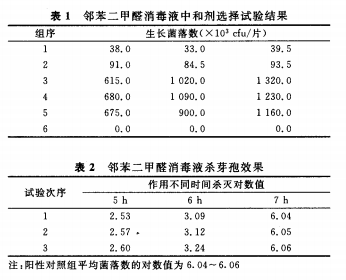
2.3 medical device disinfection simulation field test results to hemostatic forceps teeth
The carrier is the carrier, and the o-phthalaldehyde disinfectant acts for 5h, which pollutes the carrier.
The average killing of Bacillus subtilis black variant spores was 2.44.
For 6h, the average killing logarithm value is 2.94; for 7h, the killing logarithm value is
Both> 3.00.
3 Discussions
O-phthalaldehyde disinfectant is a broad-spectrum disinfectant with low
Corrosion, non-irritating, can extend the advantages of the action time, can kill Bacillus subtilis.
Black variant spores, good disinfection effect, its sterilization effect can reach glutaraldehyde
The same effect of disinfectant, the effect of mycobacteria is better than that of glutaraldehyde.
Venom, currently used in medical equipment immersion disinfection and automatic endoscopic cleaning
machine. Its dosage form is diverse, there are single, compound, sterilization effect difference is large, wide.
The disinfection of medical devices needs to be further explored.
This test shows that the effect of o-phthalaldehyde disinfectant (0.5)
6h, killing the spores of Bacillus subtilis black variant stained on stainless steel sheet
Value> 3.00; After acting for 7 hours, Bacillus subtilis black stained on the teeth of hemostatic forceps
Spore killing logarithm of color varieties> 3.00. With Yuan Guogang and other reports
Compared with Ⅲ 2], the effect is poor, which may be related to the concentration and pH of the disinfectant.
related. In addition, single-factor chemical disinfectants are usually more effective in disinfection.
Poor, compound disinfectants can improve the disinfection effect, has become in recent years.
It is a new direction of toxicant research, which needs to be further studied.
RELATED INFORMATION

Caring for life, staying away from infections, providing you with more academic programs

Caring for life, staying away from infections, providing you with more academic programs
ANNJET
Company address: 1618 Dexing North Avenue, Tianqu Industrial Park, Tianqu Sub-district Office, Decheng District, Dezhou City, Shandong Province


WebChat